
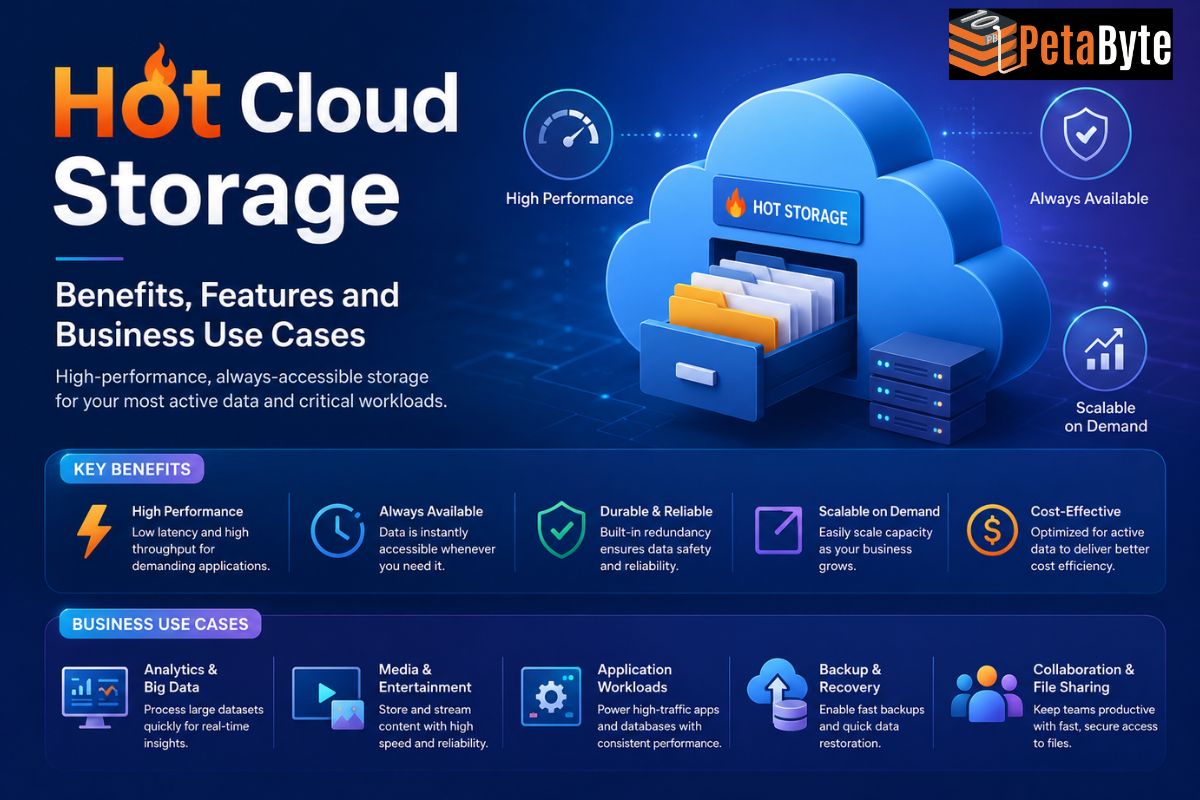
 Cloud Storage
 Hot Cloud Storage – Benefits, Features and Business Use Cases
Hot cloud storage is a type of cloud storage for data that needs to be accessed quickly and frequently. Unlike cold or archival storage that can take minutes or hours to retrieve data, hot storage provides instant access. Most hot cloud storage solutions are based on a cloud object storage architecture that gives businesses petabytes of unstructured data while remaining accessible and scalable. Object storage saves large files as objects instead of traditional files or blocks to streamline data access. Hot cloud storage is perfect for active applications, backups, customer information, digital media, and analytical workloads.
What is Cloud Object Storage?
Before going deeper into hot storage, you should know the foundation it’s built on: cloud object storage.
Cloud object storage saves data as an individual object with three main parts:
- The actual data
- Metadata
- An identifier
This architecture enables scale from terabytes to petabytes without issues associated with file system constraints. Cloud object storage is ideal for backups, archives, media and analytical files, and cloud-native applications.
What is S3-compatible storage?
The most commonly cited characteristic of contemporary object storage is S3 compatibility. S3 compatibility means that a particular storage system uses APIs that function in a similar way to those of Amazon’s S3, which is the most widely adopted object storage standard today. Using an S3-compatible storage system allows businesses to keep the software they currently utilize (backup applications, migration software, file sharing clients, etc.) without needing any modification. Using an S3-compatible storage system also offers other benefits:
- Ease of migration to the cloud
- Wide software support
- Simplified application integration
- No vendor lock-in
- Support for existing backup & recovery tools
Key Features of Hot Cloud Storage
1. Instant Data Availability
Instant access to data. Users and applications will not have to wait for data recovery procedures. That’s why hot storage is great for:
- Active business applications
- File sharing platforms
- Databases
- Customer-facing systems
2. High-Performance Cloud Storage
The most appealing aspect of hot storage is performance. High-performance cloud storage features:
- Instant upload
- Fast download
- Instant latency
- High throughout
This allows business users to support critical workloads such as real-time analysis, SaaS solutions, AI models, or media streams.
3. Massive Scalability
Businesses’ storage needs are constantly growing. Modern hot cloud storage platforms are capable of scaling up from gigabytes to multiple petabytes without interrupting current services or requiring hardware changes. This gives businesses the opportunity to:
- Increase storage on demand
- Support data growth
- adapt to changing business demands
- Enterprise Security
Security is paramount in business-critical cloud data. Enterprise-grade cloud storage systems are generally equipped with:
- AES-256 encryption
- SSL/TLS encryption of transferred data
- Multi-factor authentication
- Access control policies
- Object-level security
- Audit logging
All these options protect sensitive business data against security threats.
- Data Durability and Redundancy
Cloud object storage systems have built-in mechanisms to eliminate data loss and provide higher availability and reliability due to distributed replication of data across multiple systems.
- Predictable Cost Structure
Modern hot cloud storage solutions often provide a clear cost calculation of the storage services to prevent unexpected bills. This helps businesses avoid extra infrastructure expenses and hardware maintenance and upgrade costs. Some storage providers do not even charge for API requests or egress, simplifying financial planning.
Benefits of Hot Cloud Storage
- Instant access to business data: Employees, clients, and applications can find and retrieve critical information immediately, improving efficiency.
- Better productivity: Employees will spend less time on waiting for files to be uploaded, downloaded or synced and have more time to be productive.
- Reduced infrastructure management: Organizations can offload the entire responsibility of maintaining storage hardware to a third party.
- Enhanced business continuity: Data is readily accessible in case of any emergency or disaster and the business can carry on with its activities.
- Improved user experience: Applications utilizing hot cloud storage deliver a smoother and more efficient performance.
- Future-proof scalability: Businesses can seamlessly scale their storage capacity and always be prepared for the increasing data volumes.
Business Use Cases for Hot Cloud Storage
- Backup and recovery: Companies use cloud storage for backup and recovery to be able to restore their data as quickly as possible when a hardware failure, a human mistake, an attack or a ransomware infection occurs. Hot storage can offer immediate access to backup data and features like object versioning, object lock or immutable backup to enhance data protection.
- Enterprise File Sharing: Companies are increasingly using cloud-based storage solutions for centralization and secure file sharing among employees. Hot cloud storage solutions offer remote work functionality, real-time document sharing and centralized management of digital documents.
- Media Storage and Content Management: Any company dealing with large quantities of video files, images or digital media assets will benefit from rapid data retrieval solutions. Examples: marketing agencies, streaming services, digital content creators, media companies.
- SaaS applications: Software-as-a-Service providers require data storage solutions that can guarantee consistent performance to all users globally. Hot cloud storage allows seamless performance for application data, user-generated content, customer data and log files.
- Data lakes and analytics: A wide range of analytics platforms continually work with large datasets, and this is where cloud object storage with high performance and scalability excels. Business intelligence, big data analytics, ML pipelines and AI model training are all use cases of cloud object storage.
- Healthcare Data Storage: The healthcare industry generates and handles tremendous amounts of medical records, diagnostic imagery and operational data. Hot cloud storage provides instant record retrieval, strong security and the required disaster recovery capabilities to maintain business continuity and adhere to regulations.
- Financial Services: Financial firms rely on rapid access to transaction histories, customer records and similar data. Hot cloud storage supports real-time processing, fraud detection, and customer transaction management, and is fully compliant for regulatory reporting.
Why Businesses Are Adopting S3 Compatible Storage
The popularity of S3-compatible storage solutions is growing as organizations are not forced to re-engineer existing systems. They can still maintain compatibility with their current applications and software, simplifying migration to the cloud and also making the integration process faster. This flexibility offers businesses a viable and scalable storage solution that is highly compatible.
Conclusion
As companies increasingly accumulate massive volumes of crucial business data, the need for swift, scalable, and secure storage becomes essential. Hot cloud storage provides immediate access to actively used data and leverages the scalability and flexibility of contemporary cloud object storage systems. Combined with S3-compatible storage, enterprise-grade security, and high-performance cloud storage capabilities, it allows businesses to support active workloads, boost productivity, and enhance data security measures. Whether you’re architecting cloud-native applications, managing media assets, running analytics, or deploying cloud storage for backup and recovery, hot cloud storage provides a solid foundation for the management of contemporary data. Businesses in search of secure cloud storage solutions can make use of hot storage to ensure critical information is accessible, protected, and available whenever it’s needed.