 Cloud Storage
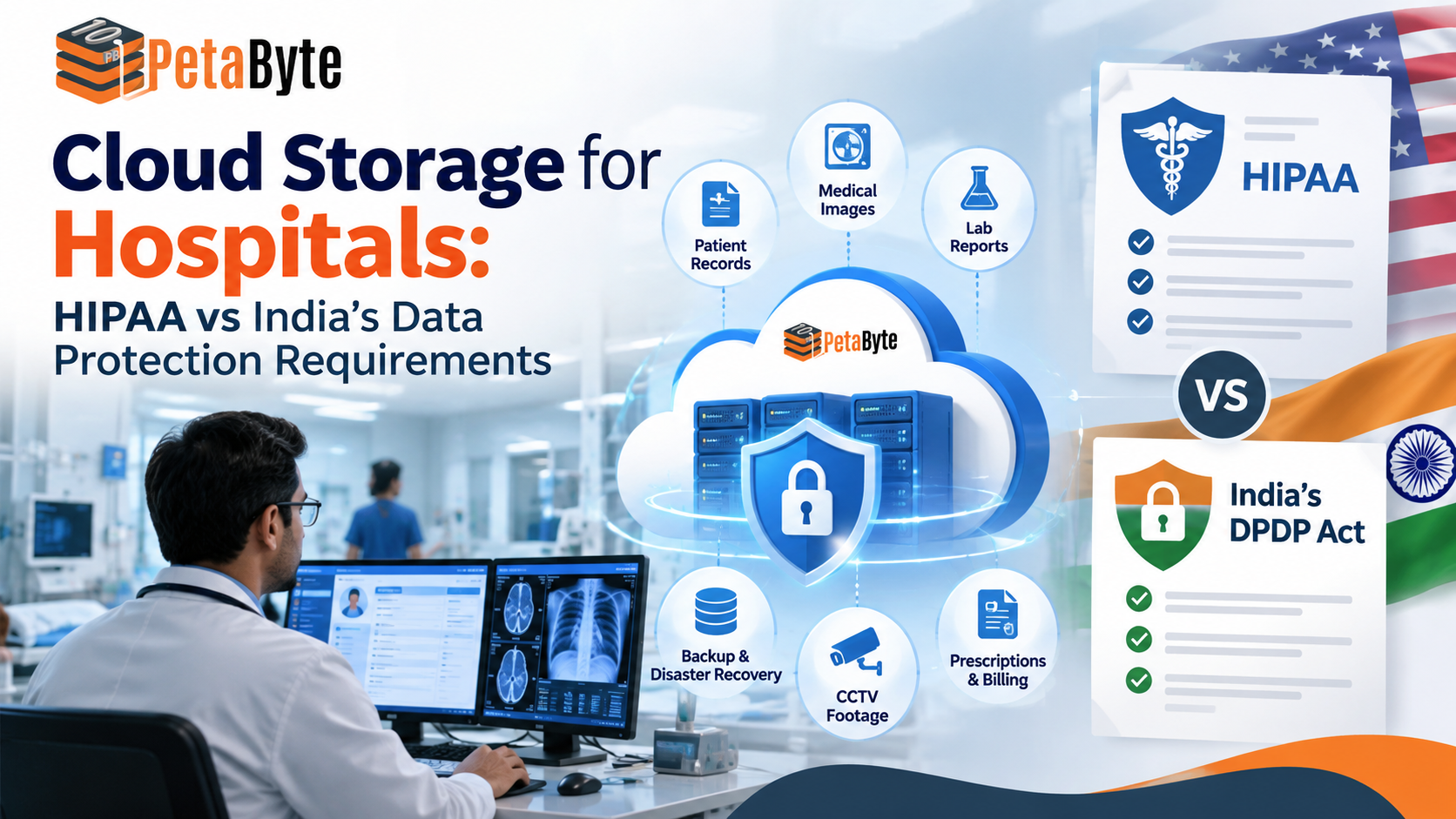
 Cloud Storage for Hospitals: HIPAA vs India’s Data Protection Requirements
A hospital can generate an enormous amount of digital information every day. Patient records, laboratory reports, medical images, prescriptions, billing documents, insurance information and surveillance footage all need to be stored securely and made available when required.
As this data continues to grow, many hospitals are moving part of their infrastructure to Cloud Storage for Hospitals. Cloud platforms can help organizations expand storage capacity, maintain backups and provide authorized staff with access to information without having to manage all storage hardware on-site.
Healthcare data, however, comes with significant privacy and security responsibilities.
A storage provider may handle information that identifies patients or reveals details about their medical conditions. This creates important considerations around data privacy, security, user access, retention and regulatory compliance.
The requirements can also vary depending on the country where the hospital operates. Hospitals in the United States may need to comply with HIPAA requirements, while Indian hospitals need to consider India’s data protection framework, including the Digital Personal Data Protection Act, 2023 and the DPDP Rules, 2025.
So, what should hospitals know before choosing a cloud storage provider?
Why Healthcare Storage Needs Extra Attention
Consider a typical hospital environment.
A single patient may have information spread across an electronic health record, diagnostic imaging system, laboratory system, billing platform and patient portal. Copies of some of this information may also exist in backup systems.
This creates several storage requirements at once.
Hospitals need enough capacity for growing datasets, but they also need controls around who can access information, how data is transferred, how backups are protected and what happens when information is no longer required.
Common healthcare datasets include:
- Electronic health records
- MRI, CT and X-ray images
- Laboratory reports
- Prescriptions
- Patient identification information
- Billing and insurance records
- Telemedicine information
- Clinical research data
- Hospital CCTV footage
- Backup and disaster-recovery data
The storage platform therefore becomes part of the hospital’s overall IT and security architecture.
What Does HIPAA Require?
HIPAA is a U.S. federal law that includes requirements relating to protected health information. Its Security Rule establishes safeguards for electronic protected health information, commonly called ePHI.
For hospitals using cloud infrastructure, one detail is particularly important.
A cloud provider that creates, receives, maintains or transmits ePHI on behalf of a covered entity can fall within HIPAA’s definition of a business associate. In such cases, the healthcare organization generally needs a Business Associate Agreement with the provider. The U.S. Department of Health and Human Services also explains that using a cloud service does not remove the healthcare organization’s responsibility for protecting its information.
This means a hospital should not select a cloud provider simply because the provider says it offers “secure cloud storage.”
The hospital needs to understand the controls around the environment, including access management, security processes, availability, backup and contractual responsibilities.
HIPAA also involves privacy and breach-notification requirements. The exact obligations depend on the organization’s role and the type of information involved.
What Is the Situation in India?
India follows a different regulatory approach.
The Digital Personal Data Protection Act, 2023 establishes a framework for processing digital personal data. It defines responsibilities for organizations that determine the purpose and means of processing personal data and provides certain rights to individuals, referred to as Data Principals under the Act.
The Digital Personal Data Protection Rules, 2025 were notified by the Government of India in November 2025. The rules provide additional details for implementing the framework, with provisions coming into effect according to the specified commencement schedule.
For hospitals, this means personal data should be considered throughout its lifecycle.
That includes collection, storage, use, sharing, security, retention and deletion.
However, it would be misleading to describe India’s DPDP framework as simply the Indian equivalent of HIPAA. The two frameworks have different scopes and structures.
HIPAA is specifically focused on certain healthcare-related entities and protected health information in the United States. India’s DPDP framework is broader and applies to digital personal data across sectors, subject to its scope and provisions.
HIPAA and DPDP: What Should Hospital IT Teams Understand?
The easiest approach is to look at the practical differences.
| Area | HIPAA | India’s DPDP Framework |
|---|---|---|
| Geographic framework |
United States | India |
| Main focus | Protected health information and covered healthcare entities | Digital personal data |
| Healthcare-specific | Yes | No; applies across sectors |
| Cloud-provider considerations |
Business associate relationship and BAA may apply | Data-processing responsibilities depend on the specific relationship and circumstances |
| Security | Administrative, physical and technical safeguards | Reasonable security safeguards and prescribed requirements |
| Individual rights | Specific rights relating to protected health information | Rights provided to Data Principals |
| Breach requirements | HIPAA contains breach-notification requirements | DPDP framework contains personal-data breach obligations |
| Cross-border | Governed within the HIPAA and wider U.S. legal framework | Cross-border processing is subject to India’s applicable legal framework and government requirements |
The key point is simple: a cloud provider should not claim that HIPAA compliance automatically means DPDP compliance, or the other way around.
Hospitals need to evaluate the laws and contractual requirements that actually apply to their operations.
What Should Hospitals Check Before Choosing Cloud Storage?
Compliance should be part of the vendor evaluation process, rather than something discussed after the storage platform has already been selected.
1. Encryption
Ask how data is protected while stored and while moving between systems.
Encryption reduces the risk associated with unauthorized access, but it should not be treated as the only security control.
Hospitals should also examine key management, access policies and other technical safeguards.
2. User Access
A hospital may have hundreds or thousands of employees using its IT systems.
A nurse, radiologist, finance employee, administrator and external technician should not automatically have the same level of access.
Role-based permissions and strong authentication can help restrict access according to job responsibilities.
3. Activity Logs
Hospitals should be able to investigate activity around sensitive information.
Useful logging can show which account accessed a resource, when the activity occurred and what action was performed.
These records can support security investigations and internal reviews.
4. Backup and Recovery
Storage is not useful if critical information cannot be recovered after a system failure.
Hospitals should ask:
- How frequently is data backed up?
- Where are backup copies maintained?
- How quickly can information be restored?
- What happens during a major infrastructure failure?
- How is backup data protected from unauthorized access?
A proper recovery strategy is especially important for systems that support patient care.
5. Data Location
Hospitals should understand where their information is stored and where copies or replicas may be maintained.
This becomes particularly relevant when the cloud provider operates infrastructure in several countries.
Instead of assuming that a particular country is automatically compliant, the hospital should review the provider’s architecture, contracts and applicable legal requirements.
6. Data Deletion and Exit
Another question often missed during cloud procurement is what happens when the contract ends.
Can the hospital retrieve its information?
How will remaining copies be handled?
What happens to backups?
When will the provider delete the organization’s data?
These details should be addressed contractually before migration.
Is Cloud Storage the Right Choice for Hospitals?
Cloud storage itself is neither automatically compliant nor automatically non-compliant.
The outcome depends on how the technology is selected, configured and operated.
For example, a hospital could have a highly capable cloud platform but still create security problems through weak passwords, excessive user permissions or poor configuration.
On the other hand, a properly designed cloud environment can provide useful capabilities such as scalable storage, redundancy, centralized access controls, monitoring and backup infrastructure.
The technology is only one part of the equation.
The hospital also needs appropriate internal policies, employee controls, vendor management and data-governance processes.
Questions to Ask a Cloud Storage Provider
Before signing an agreement, hospital IT and procurement teams can ask the provider:
- Where will our primary data be stored?
- Where will backup copies be maintained?
- Is data encrypted during transmission and while stored?
- How are encryption keys managed?
- Can access be restricted by role?
- What authentication options are available?
- Are detailed audit logs available?
- What is the backup and recovery process?
- How are security incidents handled?
- What happens to our data when the contract ends?
- What contractual commitments does the provider make regarding data protection?
- Can the provider support our specific regulatory and security requirements?
These questions can reveal far more than a generic “secure cloud” statement on a website.
Final Thoughts
For hospitals, choosing cloud storage is an infrastructure decision as well as a data-governance decision.
U.S. healthcare organizations need to consider HIPAA requirements when handling protected health information, including the responsibilities that can arise when cloud providers act as business associates.
Indian hospitals operate within a different regulatory environment. The DPDP Act and the DPDP Rules establish requirements around the processing and protection of digital personal data, with the 2025 rules providing additional implementation details.
The practical lesson for hospital IT teams is not to look for a single “compliance badge.”
Instead, evaluate the complete storage environment: security controls, access management, encryption, backup, recovery, data location, contracts, incident response and data lifecycle management.
Frequently Asked Questions
1. Is cloud storage safe for hospitals?
Cloud storage can be suitable for hospitals when the environment is properly designed and managed. Hospitals should evaluate encryption, access controls, authentication, audit logs, backup, disaster recovery, data location and incident-response processes before selecting a provider.
2. Is HIPAA applicable to hospitals in India?
HIPAA is a U.S. healthcare privacy and security framework and generally does not apply simply because an organization is a hospital. Indian hospitals need to consider the Indian legal and regulatory requirements that apply to their processing of personal data, including the Digital Personal Data Protection framework.
3. Is HIPAA compliance the same as DPDP compliance?
No. HIPAA and India’s DPDP framework have different scopes and requirements. HIPAA focuses specifically on protected health information and certain healthcare-related entities in the United States, while the DPDP framework provides a broader framework for digital personal data in India.
4. What should hospitals look for in a cloud storage provider?
Hospitals should evaluate encryption, role-based access, authentication, audit logging, backup and recovery, data location, security monitoring, incident response, contractual protections and data-deletion procedures. The provider should also be able to clearly explain how its infrastructure supports the hospital’s security and regulatory requirements.
5. Can hospitals store patient records in cloud storage?
Yes, hospitals can use cloud infrastructure for storing patient-related information, provided the solution and associated processes meet the organization’s applicable legal, security and operational requirements. The hospital should assess how the data is collected, processed, stored, accessed, backed up and eventually deleted.
6. Why is data location important for healthcare cloud storage?
Data location can affect contractual, regulatory, security and operational considerations. Hospitals should understand where their primary data, replicas and backups are stored and whether data may be processed across jurisdictions.
7. What is the difference between cloud backup and cloud storage for hospitals?
Cloud storage provides a place to store and access data, while cloud backup is primarily designed to create recoverable copies of information in case the original data is lost, damaged, deleted or affected by an incident. Hospitals may require both as part of a broader data-protection and disaster-recovery strategy.