 Cloud Storage, Object Storage
 AWS S3 vs 10PB S3 Compatible Storage: Which Saves More Money?
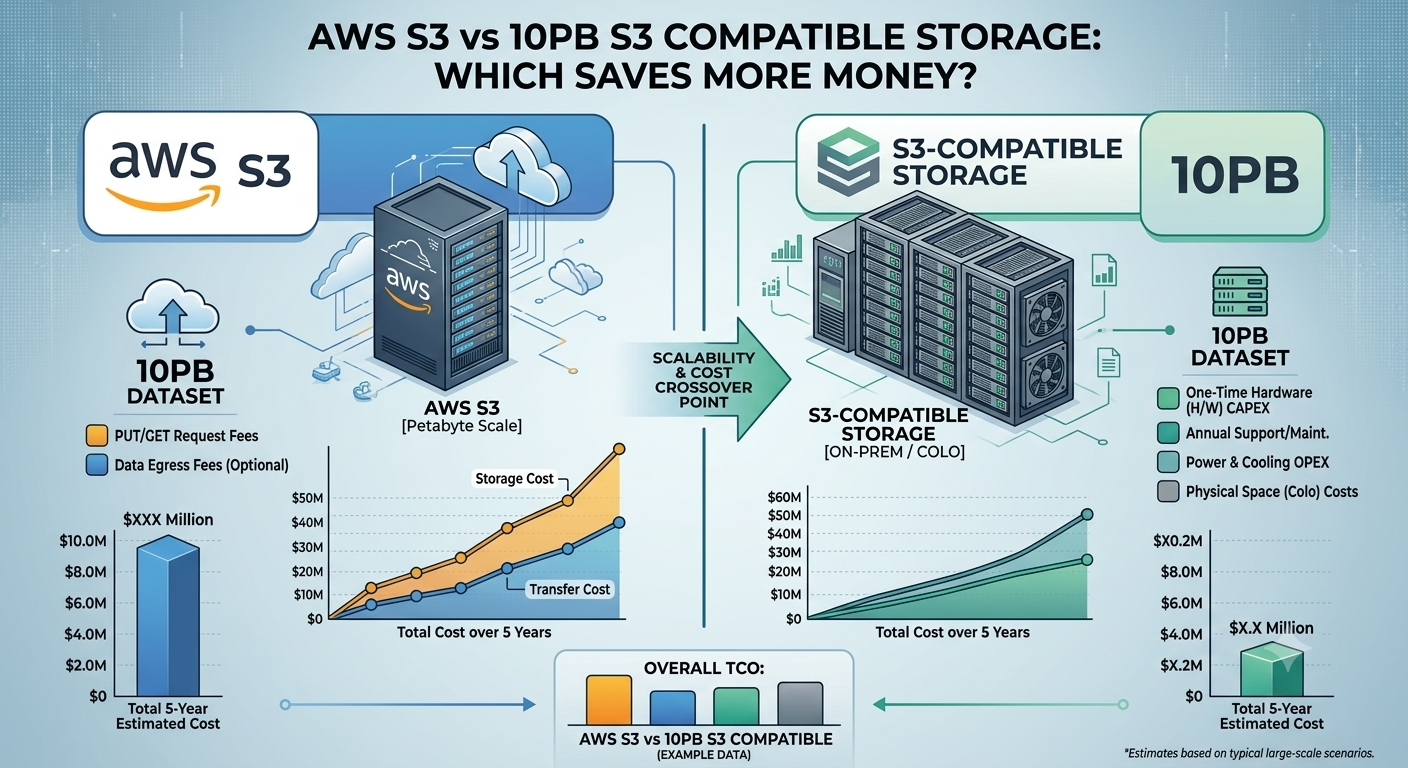
When it comes to cloud storage solutions, the decision affects your budget, scalability and business development. As you know, enterprise storage costs involve far more than paying for storage capacity. The comparison between AWS S3 vs 10PB S3 Compatible Storage helps business and technology leaders understand where costs come from, how pricing models differ, and which solution delivers better long-term value for their workloads.
Why Storage Costs Are Becoming a Boardroom Discussion
CIOs and CTOs consider cloud storage an integrated part of their business processes and don’t treat it as another infrastructure issue. Cloud storage is related to finances, disaster recovery, performance of applications and compliance with regulations.
Though it seems obvious that storing information in the cloud is easy, its total cost depends on a lot more than the monthly storage fee. There may be retrieval charges, usage of the API requests, traffic expenses and other factors influencing your total spending.
In order to select a proper storage platform, corporate executives should consider:
- Cost of ownership vs storage cost
- Data growth during the next three to five years
- Data retrieval and bandwidth requirements
- Integration with other applications and tools for backup
- Business continuity and disaster recovery
Companies analyzing all these aspects beforehand will be able to plan expenses on IT infrastructure in advance and save money on further expansion.
Understanding AWS S3 Pricing Beyond Storage Capacity
Amazon S3 became the default cloud storage provider for a lot of companies due to its global availability, reliability and rich ecosystem. This service suits organizations of any size, including small startups and multinational companies.
However, in order to understand AWS S3 Pricing one should look deeper than storage price. Growing volume of data can make other usage-based expenses considerable part of monthly cloud computing expenses.
These are:
- Storage across various classes
- Usage of APIs: PUT, GET, COPY, LIST requests
- Charges for data retrieval
- Fees for outbound data transfers
- Operations related to lifecycle management
For organizations managing hundreds of terabytes—or even petabytes—these costs can become difficult to predict, making annual IT budgeting more challenging.
Why 10PB Is a Good AWS S3 Alternative?
Many organizations consider an AWS S3 Alternative that would offer better cost predictability and application compatibility at the same time.
Here comes 10PB with S3 Compatible Storage to allow organizations to keep using applications and backup solutions based on Amazon S3 APIs and migrate from AWS while maintaining application compatibility.
It has some benefits compared to other approaches:
- Predictable storage pricing
- Compatibility with S3-enabled applications
- Simplified migration with minimum workflow change
- Highly scalable architecture
- Top-notch security and reliability
The compatibility helps to simplify migration process and save money on previous technology investments.
AWS S3 vs 10PB S3 Compatible Storage: A Cost Comparison
| Business Factor | AWS S3 | 10PB |
|---|---|---|
| Cost predictability | Variable | Predictable |
| Budget planning | More complex | Easier |
| Migration effort | Native AWS | Minimal for S3-compatible apps |
| Best suited for | AWS ecosystem | Cost-conscious enterprise storage |
For organizations experiencing rapid data growth, predictable pricing often simplifies procurement, financial forecasting, and infrastructure planning.
Likewise, businesses looking for an AWS S3 Alternative frequently prioritize cost visibility alongside technical compatibility.
Where Can Businesses Actually Save More Money?
Storage comparisons do not necessarily need to be limited to price per gigabyte per month. For companies with vast and expanding amounts of data to store, some operational costs might make the total cost of ownership more significant in the long run. Knowing these costs enables an IT manager to select the most appropriate storage solution for their organization.
Organizations can minimize their storage costs by taking into account:
- More predictable monthly storage expenses, making IT budgets easier to forecast.
- Lower operational overhead through simpler storage management and easier administration.
- Reduced migration effort because S3-compatible applications often continue working without major modifications.
- Improved scalability, allowing storage capacity to grow without frequent infrastructure redesign.
Why S3 Compatibility Matters for Enterprise IT
The replacement of storage infrastructure should not imply the redevelopment of company’s business applications.
As 10PB offers S3 Compatible Storage, enterprises can continue working with many already existing backup solutions, DevOps tools, analytics applications, and cloud-native services which support Amazon S3 API.
It decreases the risk of the migration process and saves the time needed for implementation for IT Infrastructure Managers and Cloud Architects.
Compatibility also allows preserving automation workflows created for S3 Object Storage and reduces operational disruption and retraining needs.
Which Organizations Benefit the Most?
Every industry has different storage requirements, but companies with fast-growing data volumes have a lot in common – they need predictability of their expenses, scalability of solutions, and operational efficiency.
- Financial institutions managing regulatory archives
- Healthcare organizations storing medical imaging
- Media companies with video libraries
- Manufacturing businesses working with IoT data
- Data science teams processing huge datasets
- SaaS providers serving thousands of customer workloads.
In such cases, choosing the right Enterprise Cloud Storage platform becomes not just a technical decision, but a strategic one.
IT leaders won’t need to constantly adjust the storage budget according to increased needs as they can concentrate on innovating while trusting the scalable S3 Storage Solution that enables further business growth.
Looking Beyond Cost: Performance, Scalability, and Business Value
Despite the importance of the cost, the enterprise storage solution needs to ensure business continuity and scalability of the solution.
The decision-makers need to consider if a particular platform can offer:
- High level of data durability
- Performance for critical business applications
- Scalable Object Storage technology
- High level of security and encryption
Integration with existing backup and disaster recovery strategies
An effective Enterprise Cloud Storage platform should allow organizations to expand capacity without introducing unnecessary operational complexity.
Similarly, an enterprise-grade S3 Storage Solution should support future workloads such as AI, analytics, media management, and long-term archival while maintaining consistent performance.
Modern S3 Object Storage platforms are increasingly expected to balance performance, compatibility, and predictable operating costs instead of focusing solely on storage capacity.
Conclusion
Making a choice between AWS S3 vs 10PB S3 Compatible Storage means taking into consideration not only the cost of storage but also other factors. Enterprise decision makers should think about total cost of ownership, scaling abilities, ease of operations, and compatibility with existing software before making the final decision.
While AWS S3 is an amazing storage tool within AWS cloud, some organizations may find that 10PB Storage provides for another way out offering predictability and budgeting without losing on compatibility and enterprise-grade capabilities.
Cloud Storage for Hospitals: HIPAA vs India’s Data Protection Requirements
September 26, 2026
Cloud Data Archiving: The Complete Guide for Businesses in 2026
September 7, 2026