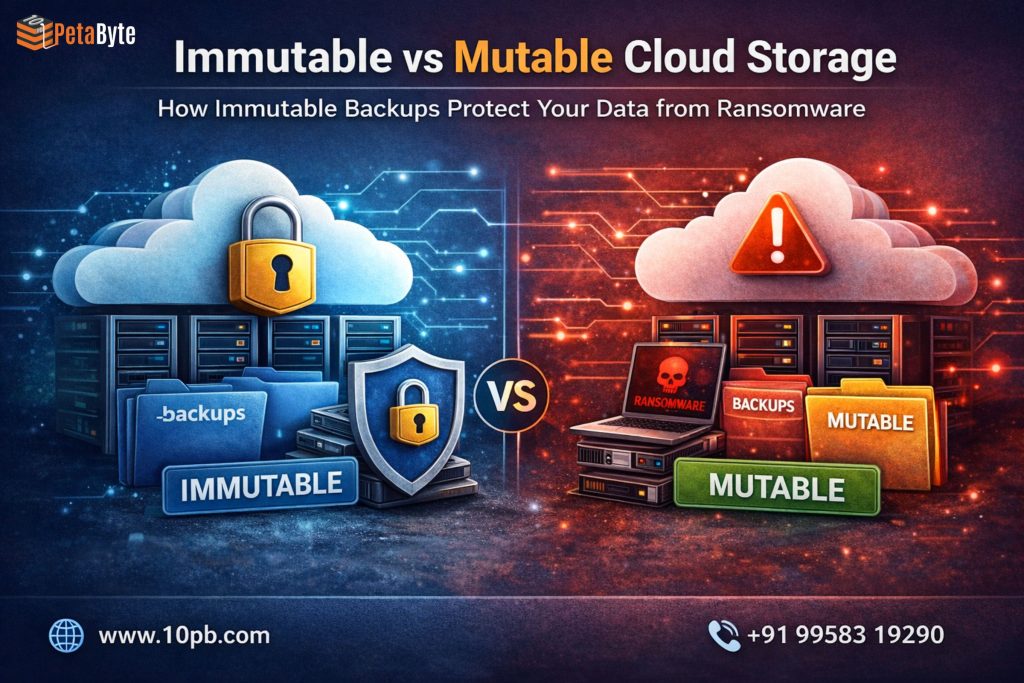
Data protection has become one of the biggest challenges for modern businesses. Organizations generate massive amounts of digital data every day, and protecting that data from cyberattacks, accidental deletion, and corruption is critical.
One concept that is rapidly gaining importance in cloud storage security is immutability.
Immutable cloud storage ensures that once data is written to storage, it cannot be modified, overwritten, or deleted for a defined period of time.
This makes storage one of the most effective defenses against ransomware attacks and unauthorized data manipulation.
On the other hand, traditional storage systems rely on mutable storage, where data can be edited or deleted at any time. While mutable storage offers flexibility, it can also expose organizations to security risks if backups are compromised, potentially leading to data loss or unauthorized access to sensitive information.
In this guide, we will explore:
- What immutable cloud storage means
- How it differs from mutable storage
- Why backups are essential for ransomware protection
- How modern cloud storage platforms implement immutability
Understanding these concepts will help organizations design a secure cloud storage strategy that protects critical data from cyber threats.
What Is Immutable Cloud Storage?
Immutable cloud storage refers to a storage system where data cannot be modified or deleted after it is written.
This concept is typically implemented using Write Once Read Many (WORM) technology.
With WORM storage:
- Data is written once
- The stored object can be accessed multiple times
- The original data cannot be changed or removed
In simple terms:
Immutable storage = permanent and tamper-proof data storage.
Once a file is stored with immutability enabled, no user, application, or even system administrator can modify it until the retention period expires.
This makes immutable storage extremely valuable for:
- backup protection
- compliance records
- ransomware defense
- regulatory data retention
What Is Mutable Cloud Storage?
Mutable cloud storage is the traditional form of storage used in most systems today.
In mutable storage:
- files can be modified
- files can be overwritten
- files can be deleted
This flexibility allows organizations to update data frequently.
Examples include:
- databases
- application data
- collaborative documents
- frequently updated files
However, mutable storage comes with a major drawback.
If attackers gain access to a system, they can modify or delete backups, which makes recovery difficult.
Mutable storage is therefore ideal for daily operational data, which means it can be changed or updated, but it is not always sufficient for secure backup protection, as it can be vulnerable to unauthorized modifications that compromise data integrity and recovery options.
Immutable vs Mutable Cloud Storage
Understanding the difference between these two storage models is critical when designing a data protection strategy.
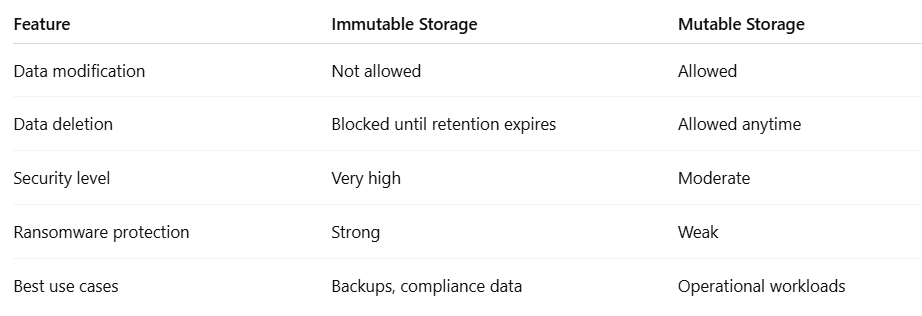
Mutable storage focuses on flexibility, while immutable storage focuses on security and data integrity.
Most modern organizations use both together as part of a balanced data architecture to leverage the flexibility of mutable storage while ensuring the security and data integrity provided by storage.
Why Immutable Backups Are Important
Traditional backups are useful, but they remain vulnerable.
Attackers today often target backup systems first, because if backups are destroyed, recovery becomes impossible.
Immutable backups solve this problem.
Backups create tamper-proof copies of your data that cannot be modified or deleted, even if attackers gain access to your system.
This ensures that organizations always have a clean recovery point.
Immutable backups provide protection against:
- ransomware attacks
- accidental deletions
- insider threats
- data corruption
- unauthorized modification
Because of these advantages, backups are becoming a standard requirement in modern backup strategies.
How Immutable Storage Protects Against Ransomware
Ransomware attacks typically work by encrypting company data and demanding payment for decryption.
Unfortunately, attackers often target backup systems as well, which prevents organizations from restoring data.
Immutable storage prevents this scenario.
Since backups cannot be modified or deleted, ransomware cannot encrypt them.
Even if attackers gain administrator access, the locked backup remains unchanged.
As a result:
- Data remains safe in immutable storage
- The organization restores the clean backup
- No ransom payment is required
Because of this capability, backups are often considered the last line of defense against ransomware.
High-Performance Computing with Dedicated Cloud Server Nvidia H100
Organizations that handle large datasets, AI workloads, or advanced analytics often require powerful infrastructure to process data efficiently. A Dedicated Cloud Server powered by Nvidia A100 GPUs delivers high-performance computing capabilities designed for machine learning, deep learning, and data-intensive applications. The Nvidia H100 architecture enables faster model training, large-scale data processing, and high-speed parallel computing. When paired with secure cloud storage and immutable backup systems, businesses can accelerate their AI workloads and ensure that critical datasets remain protected from data loss, corruption, or ransomware attacks. This combination of GPU computing and secure cloud storage creates a reliable environment for enterprises managing complex and performance-driven workloads.
How Cloud Storage Platforms Implement Immutability
Modern cloud storage platforms implement immutability using object storage architecture.
One common mechanism is Object Lock.
Object Lock allows storage administrators to define policies that prevent modification or deletion of stored objects.
For example:
- a file can be locked for 30 days
- during this time it cannot be edited or deleted
- after the retention period expires, it can be removed or archived
Many cloud storage providers implement immutability using:
- Object Lock policies
- retention rules
- legal hold mechanisms
- WORM storage architecture
These features ensure that backup data remains secure and tamper-proof.
Real-World Use Cases of Immutable Cloud Storage
Industries that prioritize data security widely utilize cloud storage.
Enterprise Backup Systems
Companies use immutable storage to ensure that backup copies remain safe from ransomware.
Healthcare Data
Healthcare organizations store medical records in storage to comply with regulatory standards, such as HIPAA, which mandates the protection and confidentiality of patient information.
Financial Records
Financial institutions rely on storage to maintain accurate transaction histories.
Legal and Compliance Data
Government agencies and enterprises store compliance records in systems to maintain audit trails and data integrity.
Best Practice: Use Both Immutable and Mutable Storage
The most effective cloud storage strategy combines both storage models.
Mutable storage handles:
- active workloads
- applications
- frequently updated files
Immutable storage protects:
- backups
- archived data
- compliance records
This hybrid approach ensures organizations get both flexibility and security.
Conclusion
Immutable cloud storage has become a critical component of modern data protection strategies.
Storage, unlike traditional mutable storage, guarantees the inability to modify or delete data once written, thereby rendering it highly resistant to ransomware and unauthorized tampering.
By using technologies such as WORM (Write Once Read Many) storage, object locking, and retention policies, cloud platforms can create secure backups that remain protected even during cyberattacks.
For businesses managing critical information, combining mutable operational storage with backup storage provides the best balance between flexibility and security.
Immutable cloud storage is rapidly emerging as one of the most dependable ways to protect corporate data as cyber threats continue to escalate.
FAQs
1. What is immutable cloud storage?
Cloud storage is a type of storage where data cannot be modified or deleted once it has been written, typically for a predefined retention period.
2. What are immutable backups?
Immutable backups are backup copies that cannot be altered or deleted, ensuring data remains safe from ransomware and unauthorized changes.
3. What is the difference between immutable and mutable storage?
Immutable storage prevents the modification or deletion of data, while mutable storage allows it to be updated or removed.
4. How does immutable storage stop ransomware?
Since backups cannot be modified, ransomware cannot encrypt or delete them, allowing organizations to restore their data safely.
5. Is immutable storage necessary for cloud backups?
Yes. storage adds an extra layer of protection and ensures that backup data remains safe even if primary systems are compromised.