Information has emerged to be among the biggest assets of any organization, be it a startup, a well-established company, or a small business that is dealing with customer records. With the growth of data volume, it becomes very inefficient and unsafe to store files on the personal computers or an external hard disk. This is the point when an NAS storage device is important.
It presents a clear, practical, and decision-maker-friendly explanation of the real-life applications of nas storage device, why businesses implement it, and the application in contemporary IT settings, unlike most competitors’ articles, which are only definition-oriented.
What Is an NAS Storage Device?
A NAS (Network-Attached Storage) device is a standalone storage platform that is attached to your network. It enables more than one user and application to get access to files in a single centralized location. A NAS storage device can also consolidate all of the data in a secure and manageable fashion, compared to storing data across the laptops, desktops, and the many servers scattered across.
Imagine NAS as a closed, 24/7 file repository that you and your team can use at any time and will not have to completely depend on the general cloud services.
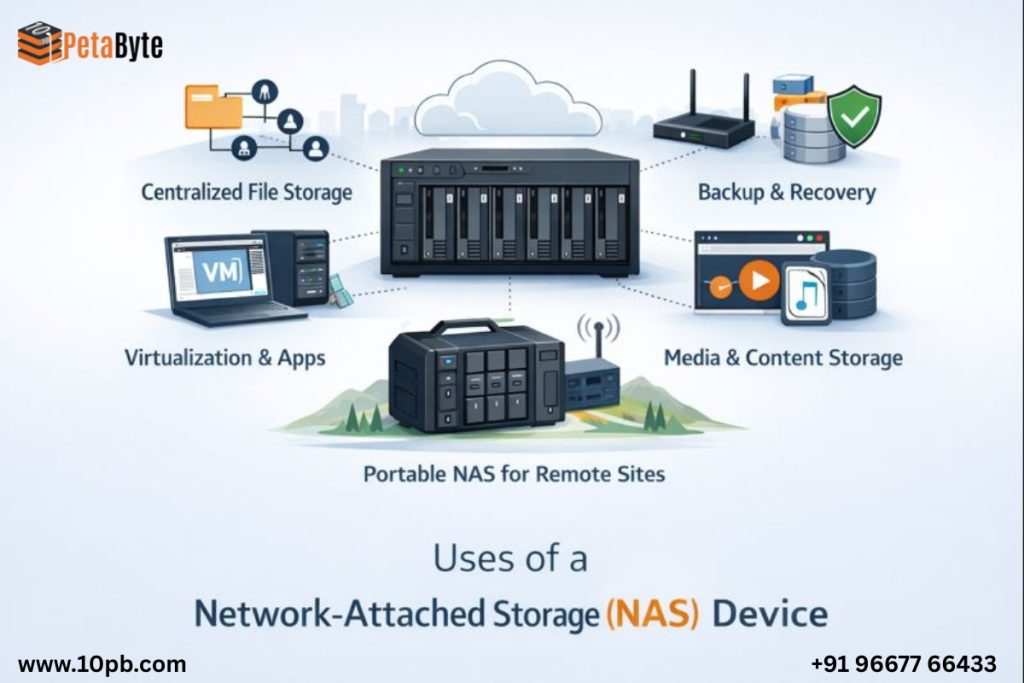
Common Uses of a NAS Storage Device
1. Centralized File Storage for Teams
Centralized file storage is one of the main applications of NAS storage devices. All business documents, spreadsheets, presentations, and media documents are hosted under a single location.
This helps organizations:
- Avoid data silos
- Improve team collaboration
- Regular access/edit control of files.
- Reduce accidental data loss
In the case of expanding companies, this structure adds clarity and regularity to the everyday activities.
2. Reliable Backup and Data Protection
It is very common to back up using an NAS storage device since it is a continuously running operating system and can be automated. Data can be backed up with no human intervention through systems, applications, and endpoints.
Key advantages include
- Planned and automatic backup.
- Snapshot-based recovery
- Shorter intervals in restoring during failures.
- In case of accidental deletion protection.
Due to the rise in cyber threats, a lot of businesses are implementing NAS as a component of a layered backup solution, which may or may not be accompanied by offsite or cloud replication.
3. Supporting Virtualization and Business Applications
The current NAS storage device systems are capable of supporting business applications and virtual machines. This renders them appropriate to be used as a shared workload without any elaborate infrastructure.
Comparing SAN vs. NAS storage, it is common to use SAN in very high-performance databases, whereas NAS is effective in file-based workloads, application storage, and backups. NAS provides sufficient performance with much less complexity to many organizations.
4. Media Storage and Content Management
NAS is much used by industries that deal with large files, e.g., media, education, design, and marketing.
Typical use cases include:
Storage of video and audio files.
- The control of digital libraries of content.
- The ability to support several editors simultaneously.
- Storing huge project files.
A properly set up NAS storage solution will make access to big files hassle-free and will not affect the pace of teams.
5. Portable NAS Storage for Remote Locations
Mobile NAS storage would be of more benefit to companies that have in-office branches, outlets, or on-site projects. These small systems are able to give local access to data and synchronize with a central location.
They are commonly used for:
- Branch office file sharing
- Temporary project sites
- Edge data collection
Local backups Can be made locally with central visibility.
Portable NAS is flexible and also has some form of control; it is particularly required where there is no reliable internet connection.
Understanding NAS Storage Price
When considering NAS storage price, the cost of the hardware should not be the only thing in consideration. Pricing is based on a number of factors:
- Total storage capacity
- Type of drives (HDD or SSD)
Performance and caching features: performance and caching.
- Data protection (RAID, snapshots)
- Software capabilities
- Support and maintenance
A low initial expense is not necessarily better value when there is a constraint on scalability and reliability.
NAS Storage Price in India: What Businesses Should Know
The price of NAS storage in India is highly fluctuating depending on the storage capacity and the brand and model of support. Simple systems might be appropriate in small teams, but a mid-sized or a large organization might require scalable systems.
Indian business ought to take into consideration:
- Local technical support
- Power efficiency
- Long-term upgrade paths
Compliance and location of data requirements.
NAS will frequently provide a lower overall cost of ownership in the long term compared to complex enterprise systems.
NAS vs SAN: Which One Fits Your Needs?
The SAN vs. NAS storage comparison is usually reduced to the type of workload.
NAS can be used well in file sharing, backups, collaboration, and storage of media.
SAN is configured to work with block-based storage and high-performance databases.
To the majority of SMBs and most businesses, NAS provides the correct mix of performance, cost, and simplicity.
Why NAS Still Matters in a Cloud-First World
NAS is very relevant even with the increased use of clouds. Some of the uses of NAS by organizations include:
- A private cloud foundation
- A hybrid storage layer
- A safe, premise-based data storage.
NAS provides businesses with control over details, predictable performance, and scalability, particularly latency, compliance, or cost issues.
FAQs: Network-Attached Storage Devices
What is an NAS storage device mainly used for?
NAS storage devices are primarily applied to store files centrally, for backups, for teamwork, and to share information on a network safely.
How does NAS differ from SAN storage?
During SAN vs. NAS storage, NAS is easy to handle file-level data and is easier to manage, whereas SAN is more complex and costly as it operates block-level data.
Is portable NAS storage suitable for businesses?
Indeed, the portable NAS storage suits remote offices, branch offices, and temporary deployments that require local access and central control.
How much does an NAS storage device cost in India?
The prices of NAS storage in India vary according to their capacity and functionality, starting with rudimentary systems and going up to the sophisticated ones used by enterprises.
Can NAS work with cloud storage?
No, a high number of businesses deploy NAS with cloud storage to develop a model of control-cost-scalability.
Conclusion
A NAS storage device is not just a storage box—it’s a practical, scalable solution for An NAS storage appliance is not simply a storage box but a practical appliance that is scalable and can be used to handle business data with a lot of ease. NAS remains one of the most effective and affordable solutions for contemporary organizations, whether it is the cost of NAS storage, the comparison between SAN storage and NAS storage, or portable NAS storage.