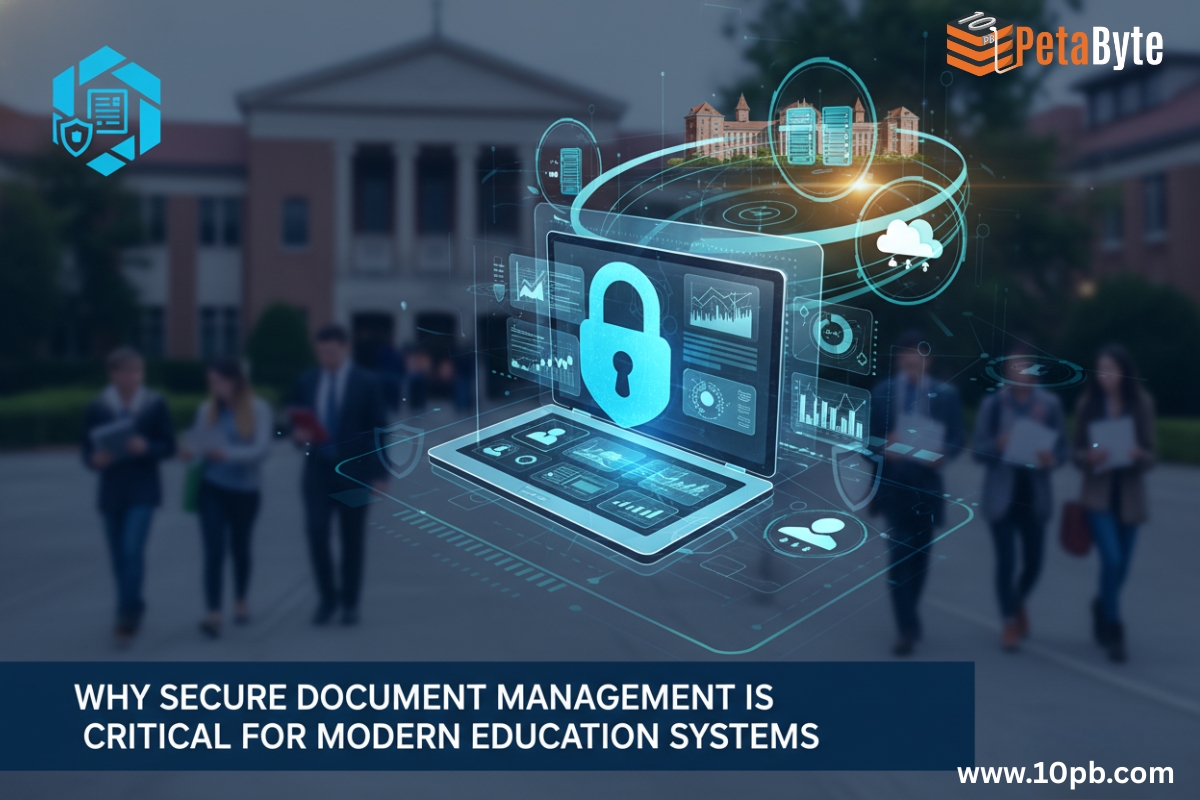
The process of education is becoming more dynamic than ever. In schools, universities, and other training institutions are moving towards digital learning facilities, cloud computing, and online collaboration systems. Although the changes enhance accessibility and innovation, they also present a significant challenge: how to manage and protect enormous amounts of sensitive data.
Educational organizations deal with very sensitive information on a daily basis; student records, examination materials, research documentation, and administrative files are some of the information that is very confidential. With no adequate security and organized education storage facilities, institutions are subject to information breaches, ransomware assaults, compliance challenges, and operational hindrance.
This is what makes safe document management and advanced education storage policies crucial to gaining a position as future-providing education systems.
The Digital Transformation of Education and Data Growth
The shift to online and digital classrooms has dramatically led to the generation of data. In educational institutions, there is storage of:
Student personal records and academic records.
- Multimedia materials and learning materials.
- Research information and intellectual property.
- Banking records and in-house communication.
- Remote collaboration files
In most institutions, the systems are still in a disjointed state or using traditional ways of storage, which results in inefficiencies and security threats. An organized education storage system will make data centralized, organized, and readily available to authorized personnel.
Effective document management provides educators and administrators with the opportunity to concentrate on educating and innovating, as opposed to losing and hacking files.
Cybersecurity Risks Facing Modern Education Institutions
The cybercriminals are also targeting education organizations more, as they possess rich personal and research information. The attack of ransomware may make institutions unable to access their systems, which results in downtime and loss of money.
Common risks include:
- There is unauthorized access to student records.
- Accidental data deletion
- Malware/ransomware attacks.
- Loose access control policies.
Education Cloud backup can be used to handle these threats by ensuring that there are secure and automated backups. Although critical systems may be exposed to damages, institutes may still restore data within a short time and proceed with their activities without significant losses.
Compliance and Data Governance in Education Sector
The educational institutions are required to adhere to the stringent data protection rules and regulations. Secure document management systems assist in complying with the requirements by providing:
- Encryption of data and safe education storage.
- Audits and access controls.
- Role-based permissions
Secure the archival and retention policies.
The employment of credible cloud computing in education sites assures that the institutions would be able to guarantee conformity and would also ease the IT administration.
Remote Learning Requires Secure and Flexible Access
Most education systems in India have now become used to hybrid and remote learning models. Learners and teachers require the ability to access resources with high security at any place—be it at home, at college, or by use of phones and tablets.
Nevertheless, the conventional local education storage poses some dangers when the data is downloaded to the personal gadgets.
The safer alternative is a cloud desktop in education. Users are not storing the data on a local system but accessing a virtual environment that is created in the cloud as a secure location. This ensures:
- Secure remote access
- Consistent performance
- Sensitive information has a centralized control.
Why Educational Storage Is More Than Just Cloud Space
Contemporary learning education storage systems are not mere file depositories. They also contain smart capabilities that are aimed at improving productivity and security.
Data management through centralization.
Every single file exists in a single organized setting, eliminating duplication and perplexity.
Collaboration Without Risk
Teachers and students are always able to collaborate and work on documents and have version control.
Automated backup and recovery.
Cloud-to-cloud backup of educational institutions ensures that collaboration tools or cloud-based data are constantly safeguarded.
Scalable Infrastructure
Cloud-based education storage increases with the increase in the institutional demands without the frequent hardware upgrading.
Real-World Use Cases for Secure Document Management
Research Institutions and Universities.
Researchers produce massive amounts of data that need to be shared and preserved. Systems of structured education storage are used to safeguard intellectual property and facilitate cooperation.
Educational and Training Centers.
The administrators take care of admissions, attendance, and academic records. Document management ensures that the work done manually is minimized and that operations become more efficient.
Multi-Campus Networks Education Authorities.
The centralized platforms are effective in managing several campuses and ensuring compliance and visibility of the data.
The Role of Dedicated Infrastructure in Education
Cloud service is flexible, but there are institutions that demand the sophisticated control and performance features. A dedicated server provides:
- Single-stack infrastructure to support high levels of security.
- High-performance computing solution: Research and analytics.
- Institutional-specific configurations.
- Increased protection of sensitive data environment.
A hybrid model can be achieved by integrating committed infrastructure and cloud backup.
Key Features to Look for in Education Storage Solutions
The institutions must consider the following when selecting secure document management systems:
- End-to-end encryption
- Automated backups
- Secure remote access
- Ready to comply with infrastructure.
- Learning platform integration.
- Expandable education storage capacity.
Solutions such as 10pb.com offer safe cloud storage that is capable of safeguarding data against ransomware, deletion, and operational risks as well as enabling remote collaboration.
Benefits of Cloud Computing for Education
Implementation of cloud computing in education has a number of strategic benefits:
- Better interaction between students and instructors.
- Lower infrastructure expenditures.
- Improved data reliability and power outage.
- More rapid implementation of online tools.
- Simplified IT management
Cloud systems enable institutions to grow in a short time without a complicated hardware investment.
How Secure Document Management Improves Learning Outcomes
Safe systems do not only concern technology:
- Teachers are able to get materials in real-time.
- Students work together regardless of the geographical location without difficulty.
Workflow is handled effectively by administrators.
IT teams are less concerned with troubleshooting education storage problems; rather, they are working on innovations.
With data sorted and protected, the whole education system is more productive.
Conclusion: Building a Future-Ready Education Environment
Modern education systems no longer have the option of not using secure document management. The institutions in India need to implement organized educational storage policies to manage the increased data volumes, changing cybersecurity risks, and rising compliance demands.
Institutions can establish robust digital ecosystems by introducing cloud backup of education systems, safe remote environments to support education such as cloud desktop education, and robust infrastructure such as dedicated server solutions.
Other websites, such as 10pb.com, provide scalable and secure education storage solutions that enable educational organizations to safeguard their data, streamline their management, and concentrate on providing improved learning experiences.
“Educational institutions handling sensitive data can strengthen their infrastructure by combining secure cloud storage with an Npod micro data center, ensuring better performance, local data control, and enhanced security.”
FAQs
- What is educational storage?
Educational storage is the secure education storage platform created to handle, store, and safeguard academic and administrative data as well as allow convenient access.
- What is the significance of cloud backup used in education?
Educational cloud backup means that in case of cyberattacks, accidental deletion, or system breakdown, data may be restored in a short period of time.
- What is cloud-to-cloud education backup?
It is automatic in safeguarding the information held in the cloud applications through the formation of secure secondary backups.
- What is the benefit of cloud desktop in education as far as security is concerned?
An educational cloud desktop stores information in safe cloud servers rather than local machines, minimizing the chances of exposure.
- What are the conditions under which schools should use a dedicated server?
A dedicated server is the one that is appropriate in the case of institutions that have a great need in terms of high performance, advanced control, or a specialized application.
- What is the role of cloud computing in education in digital learning?
Education cloud computing provides secure distance access, scalable architecture, and effortless cooperation.